7 Marketing Skills I’m Learning to Get Hired: How to Build a Practical Skill Stack
Trying to get into marketing is weirdly confusing. The advice you find online is almost always the exact same generic loop: learn SEO, learn content, learn ads, learn analytics, learn email, learn AI, and learn branding.
The industry constantly tells you to learn everything.
The problem is that when you try to master every single topic at once, you usually end up with a massive mountain of information, but without a lot of real skill.
Let me give you a quick update on my own situation. I’m Yan. I am 24 years old, and I recently graduated with my International Business degree from LAB University of Applied Sciences here in Lahti, Finland. If you’ve followed my earlier logs, you know I previously ran an AI-powered marketing agency called ArcInfini. I recently made the intentional decision to close the agency so I could focus 100% of my energy on building my own personal brand under my own name.
To keep myself grounded and pay the bills, I still work 30 hours a week at Wolt Market—though I was recently promoted to Grocery Associate Shift Lead. Because my time is split strictly between managing shifts and building my brand, I don't have room for fluff. I need marketing skills that actually make me useful.
Getting hired in modern marketing is not about knowing the most buzzwords. It’s about building a practical stack of skills that makes you dangerous in the real world.
Instead of trying to master all of marketing at once, I am focusing on seven core skills. Together, they help you understand the customer, create better messaging, get attention, measure performance, and actually prove you can execute the work.
Here is the exact 7-skill stack I am prioritizing to build my brand, and how you can practice them to create your own proof.
1. Copywriting (Messaging)
Marketing is mostly communication. If you cannot write a clear headline, a strong call-to-action (CTA), a landing page message that connects, or a useful email, everything else you build gets weaker.
A lot of beginners confuse standard writing with copywriting. Nice writing sounds pleasant, but good copy actually moves someone to take an action. I am focusing less on trying to sound clever and much more on learning how to communicate value clearly.
How to practice it: Draft layout copy for landing pages, write multiple ad angles for products you use daily, and construct click-worthy subject lines for email newsletters.
2. Content Marketing (Distribution & Outcomes)
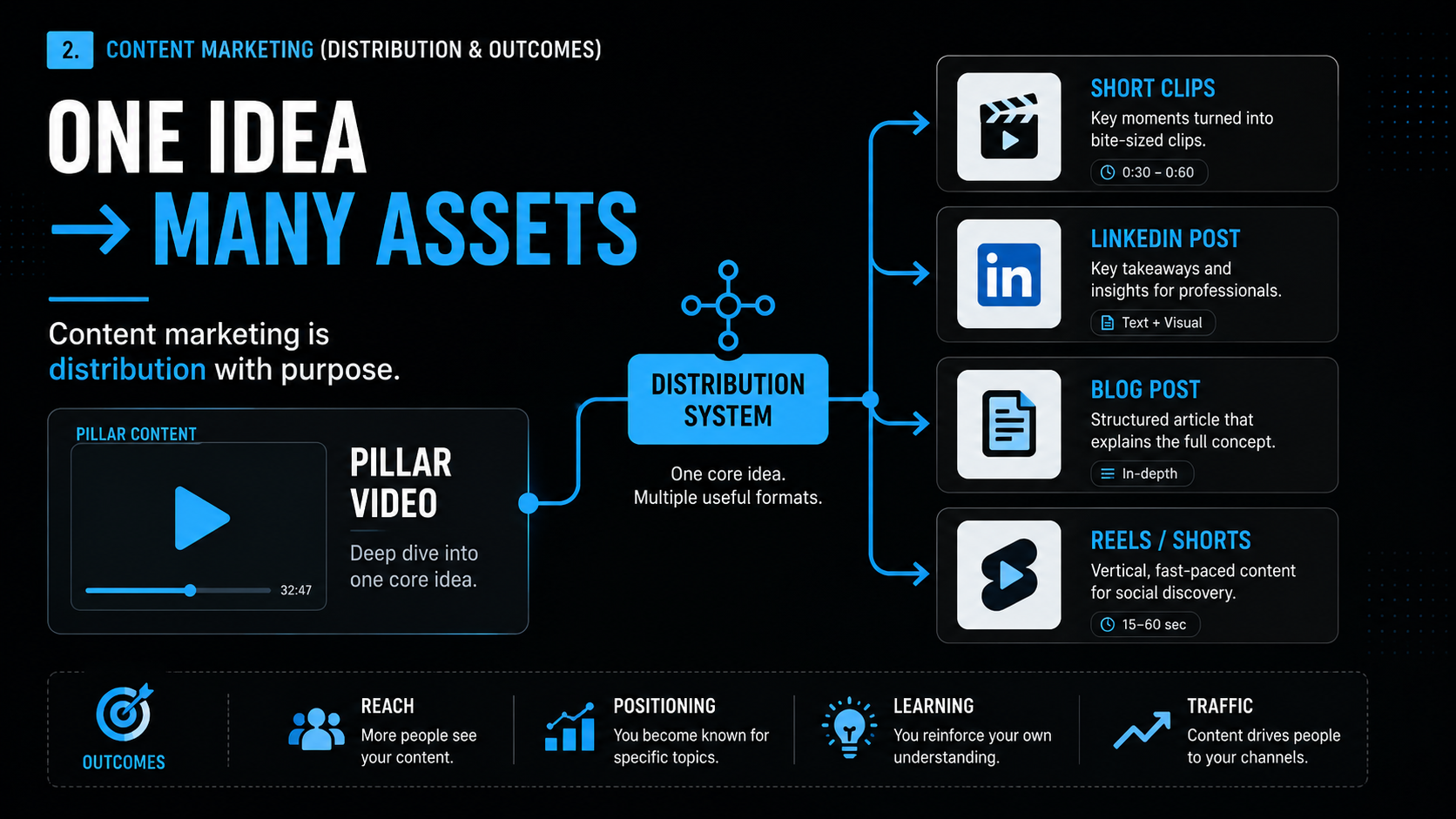
Content marketing does not mean just posting random updates online. It means knowing how to turn a single core idea into content that serves a specific business purpose.
The reason most people create content that goes nowhere is that they focus entirely on creation while ignoring distribution strategy and measurable outcomes. I want to get better at making content that is highly useful, positioned well, and directly tied to a real strategy.
How to practice it: Take one long-form pillar piece of content—like a deep video—and build a distribution system. Chop it into short clips for TikTok, Instagram Reels, LinkedIn, and YouTube Shorts, and turn the core concepts into a structured blog post.
3. SEO & Search Intent (Discovery)
Once you create content, the immediate next question is: how do people actually find it? That leads straight into SEO, specifically understanding search intent.
SEO is not about stuffing keywords into paragraphs to trick a search engine. It is about understanding exactly what a human being is looking for and building the absolute best page to answer that exact intent. SEO teaches you market demand. It forces you to think about what people already want, not just what you want to talk about.
How to practice it: Stop opening expensive keyword tools first. Instead, map out clean content clusters and practice reading real-user behavior inside Google Search Console.
4. Marketing Analytics (Measurement)
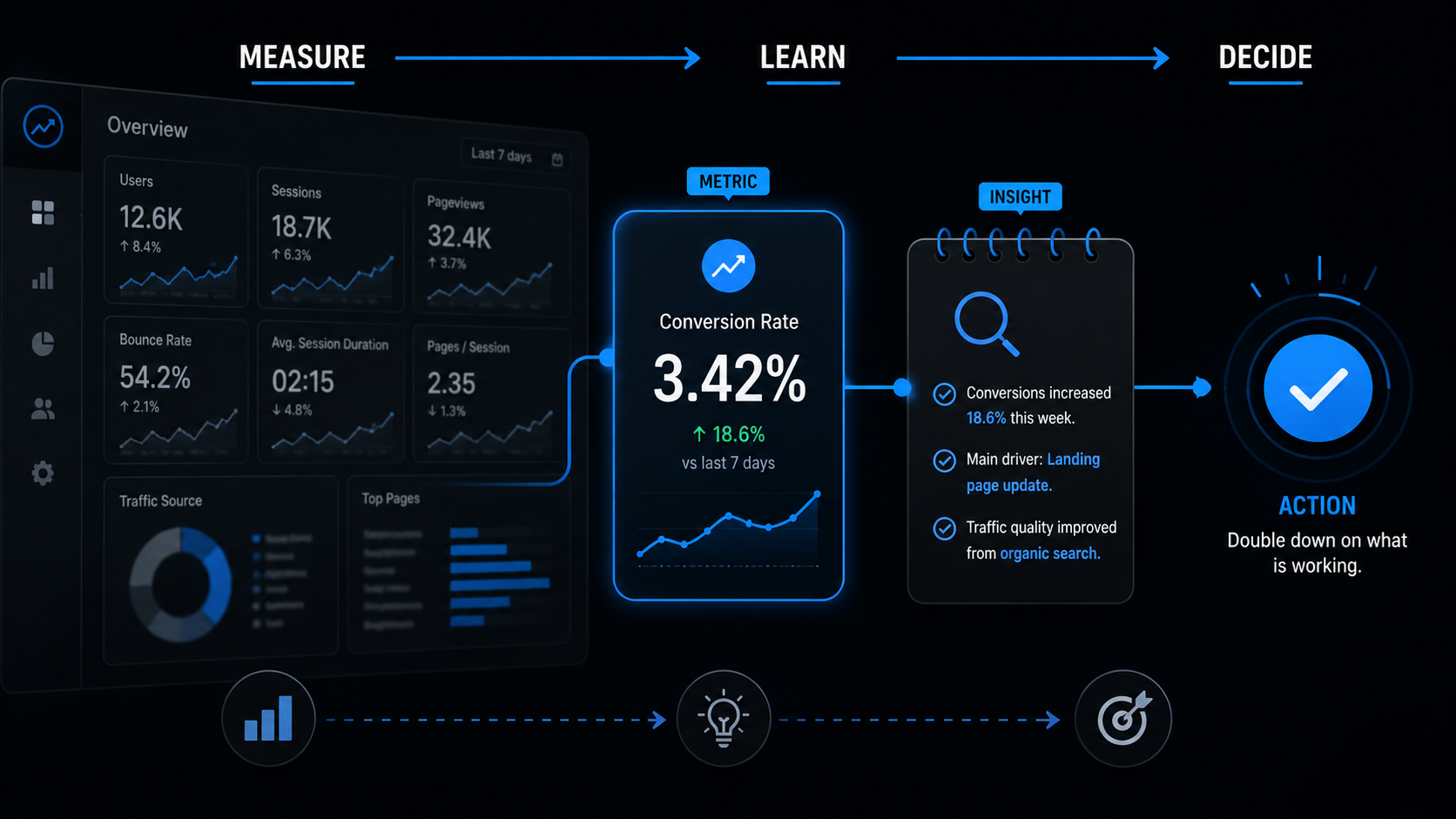
Traffic and impressions don't mean anything unless you can measure what is actually working. Without analytics, marketing is completely reduced to guesswork.
This is where most beginners get stuck. They open Google Analytics, see a massive wall of numbers, and still have no idea what it actually means. Having data is completely different from knowing what decision that data should drive.
How to practice it: Build a basic measurement routine. Go through your dashboards on a weekly basis—focusing on one metric at a time—and explicitly note down weekly insights on how those metrics changed and why.
5. Paid Ads Fundamentals (Acquisition)
You do not need to become a world-class media buyer immediately. The reason I am learning paid ads fundamentals is because paid media teaches you sharp performance thinking.
Many beginners think running ads is just pushing buttons to launch a campaign. The real challenge is tracking metrics, testing creative variations, optimizing landing pages, and making sure you don't waste money. Paid ads force instant market feedback: you test an idea, and the market responds immediately.
How to practice it: Set up small-budget creative experiments. Tweak simple landing page elements and observe exactly how your changes impact click-through rates (CTR) and bounce rates.
6. CRM & Email Marketing (Retention)
Getting attention is only half the battle; keeping people engaged over time is a whole different monster. Aspiring marketers often ignore CRM and email because retention sounds way less exciting than top-of-funnel growth.
But real marketing is about what happens after someone finds you. An email strategy sounds incredibly simple until you run into spam deliverability, list segmentation, and complex workflow logic. I want to learn how to nurture attention, not just chase it.
How to practice it: Map out foundational email sequences on paper or a free tool. Practice designing a clean welcome flow, a value-driven nurture flow, a re-engagement sequence, and the segmentation logic behind them.
7. AI & Automation (Leverage)

When your fundamentals are solid, AI becomes an incredible lever for your workflow—but it is a leverage tool, never a replacement for real human thinking.
Right now, AI is wildly overhyped and heavily used to speed up bad thinking. That pattern just creates generic, low-quality work much faster. I am interested in using AI to optimize workflows, research faster, repurpose content seamlessly, and automate repetitive tasks without lowering the quality of the output.
How to practice it: Build explicit execution systems. Set up automated research workflows, content repurposing templates, or simple lead enrichment automations.
Building a Connected System
The biggest takeaway from my journey so far is that these seven skills are not separate, isolated boxes. They form a deeply connected ecosystem.
Copy sharpens your Content.
Content feeds your SEO discoverability.
Analytics tells you exactly what part of your content is working.
Paid Ads sharpens how quickly you test your messaging.
Email & CRM protects your audience retention.
AI & Automation helps you execute the entire loop significantly faster.
The real value isn't in memorizing random marketing terms; it's in building a connected system of practical skills.
Learning these seven skills won't automatically guarantee a job tomorrow. But building this practical stack makes you infinitely more employable. It transforms you from someone who just says they are "interested in marketing" into a practitioner who can walk into a room with visible proof of execution and actually contribute.
Stop trying to read every marketing guide on the internet. Pick your stack, build your project, create proof that you can do the work, and make yourself genuinely useful.
