How I’d Learn Marketing From Zero in 2026 (If I Had to Start Over)
Most people who try to learn marketing make the same mistake.
They try to learn all of it at once.
They jump from SEO to copywriting. Then they skip over to content production, paid ads, branding, AI tools, and social media growth tactics. You spend months consuming endless hours of YouTube videos, but when you shut your laptop, you realize you are still completely confused.
Marketing is not impossible to learn. You are just learning it in the wrong order.
If I lost all my marketing knowledge and had to start completely over from scratch right now, I wouldn't try to master everything at the same time. I would focus on only four layers, heavily prioritizing clarity and real-world execution.
Here is exactly how I would build my marketing skills from zero without wasting months of time on the wrong things.
Layer 1: Master the Core Fundamentals (Not Textbooks)
Beginners often freak out over platform tactics before they even know who they are trying to persuade. I know this because I have been there myself. They try to write hooks without knowing their audience, or they set up ads without a clear offer.
Fundamentals are not abstract definitions you copy from a textbook. To understand the core of marketing, you only need to answer a few simple questions:
Who is this for?
What do they actually want?
What are you offering them?
Why should they pay attention to you?
What specific action makes them buy or sign up?
You also need to understand the difference between strategy and tactics. Strategy is deciding what game you are playing. Tactics are simply the moves you use within that game.
The Simple Version: Marketing is not just about posting content. Marketing is moving the right person to the right action.
To keep my thinking practical, I rely on a simple 5-part model: Audience → Message → Offer → Channel → Conversion.
If you sell a digital product to students, your message, platform selection, and language must directly match student problems. If you ignore this foundation and just copy-paste trending tactics, your marketing will never connect with real people.
Layer 2: Understand Modern Discoverability
Once you understand the basics, you have to look at how people actually find information right now. In 2026, visibility is highly fragmented. The old way of just googling a keyword is changing. People are searching inside YouTube, TikTok, Instagram, online marketplaces, and increasingly through AI search engines.
If nobody can discover your work, nothing else you do matters.
As a beginner, you must understand the difference between Search and Discovery:
Search: This is when a person is actively looking for a specific answer to a problem.
Discovery: This is when someone wasn't looking for you at all, but your content caught their eye and forced them to pay attention.
Your content must match how these different platforms behave. YouTube rewards deeply useful, searchable content. Short-form platforms reward instant attention. AI search tools reward highly structured, specific, and clear text.
Instead of getting overwhelmed by algorithms, focus entirely on learning the basics of platform packaging: how to write good titles, how to design click-worthy layouts, and how to craft strong video hooks.
Layer 3: Build an AI-Assisted Learning Workflow
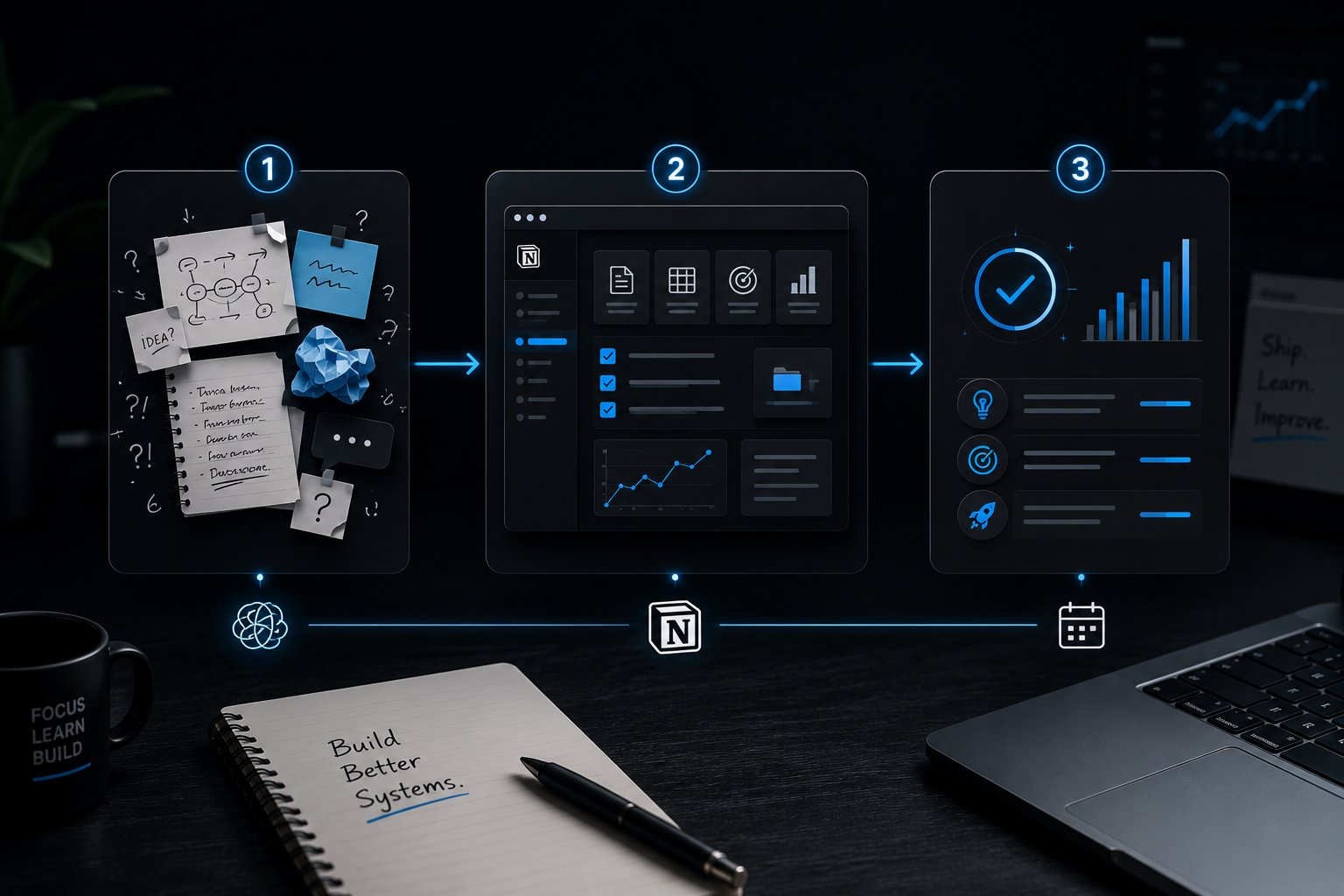
The point is not to use AI as a shortcut for thinking. The section argues that beginners should use AI to reduce friction, organize messy ideas, compare examples, build study guides, and review learning regularly — while still keeping human judgment in control.
When you are starting out, you need to learn how to move fast without falling into the trap of "fake productivity".
When it comes to AI, beginners usually fall into two dangerous extremes. They either ignore AI completely, or they use it so much that they stop thinking for themselves. To be completely transparent, I have made both of these mistakes.
AI tools should reduce the friction in your workflow and help you process information faster—they should never replace your human judgment.
Here is exactly how I use AI to study and work efficiently from my desk:
Brain-dumping projects: I talk directly into my AI tool, unloading all my messy thoughts about a project, and use it to brainstorm structural ideas.
Analyzing and comparing assets: I upload landing pages, ad copies, or video scripts to see what works and what doesn't. AI is exceptionally good at comparative analysis.
Building study guides: I upload specialized PDFs or video transcripts into tools like NotebookLM or Notion to cross-reference concepts and ask specific questions
[Messy Thoughts/Notes] ──> [One Central AI/Notion Project] ──> [Weekly Synthesis & Review]
The golden rule here is to keep everything in one cozy corner[cite: 1, 3]. Don’t scatter your data across five different tools. Keep your notes, observations, and prompts in one dedicated project file inside your preferred LLM or Notion workspace.
At the end of every week, run a simple review. Ask your AI assistant: What did I test this week? What failed? What did I actually learn? Verify the data blindly because AI can hallucinate, but use the system to keep your execution friction-free.
Layer 4: Get Real Reps (The Part That Makes it Click)
Let this sink in: You will never learn marketing by just consuming marketing videos.
Marketing only starts making sense when you are actively trying to get a real person’s attention, trying to make them care, and moving them to take action.
I learned this the hard way, and truth be told, I am still learning every day. I am not a polished guru; I am documenting this process as I build my own projects. If I had to start over, here is how I would practice getting real reps:
Pick a specific niche, a small project, or a local business.
Create content consistently around that topic.
Write copy, look at the metrics, and rewrite the low-performing versions.
Analyze winning ads and landing pages to understand why people click.
Document the entire process.
One proper marketing post that you actually publish, track, and review will teach you more than five hours of passive video tutorials. Build things. Post things. Test things. Observe the real-world reaction. It can be intimidating at first, but that is exactly why it is fun.
What to Ignore at the Start (Rapid Fire)
To protect your time and energy, completely cross these off your list during your first few months:
❌ Trying to master every single social media platform at once.
❌ Obsessing over complex paid ad budgets too early.
❌ Buying high-priced courses (I am guilty of this one).
❌ Copying massive creators without understanding their foundational strategy.
❌ Overusing AI to make your writing sound overly polished and robotic.
❌ Confusing passive content consumption with actual skill-building.
Your 4-Week Roadmap to Starting Over
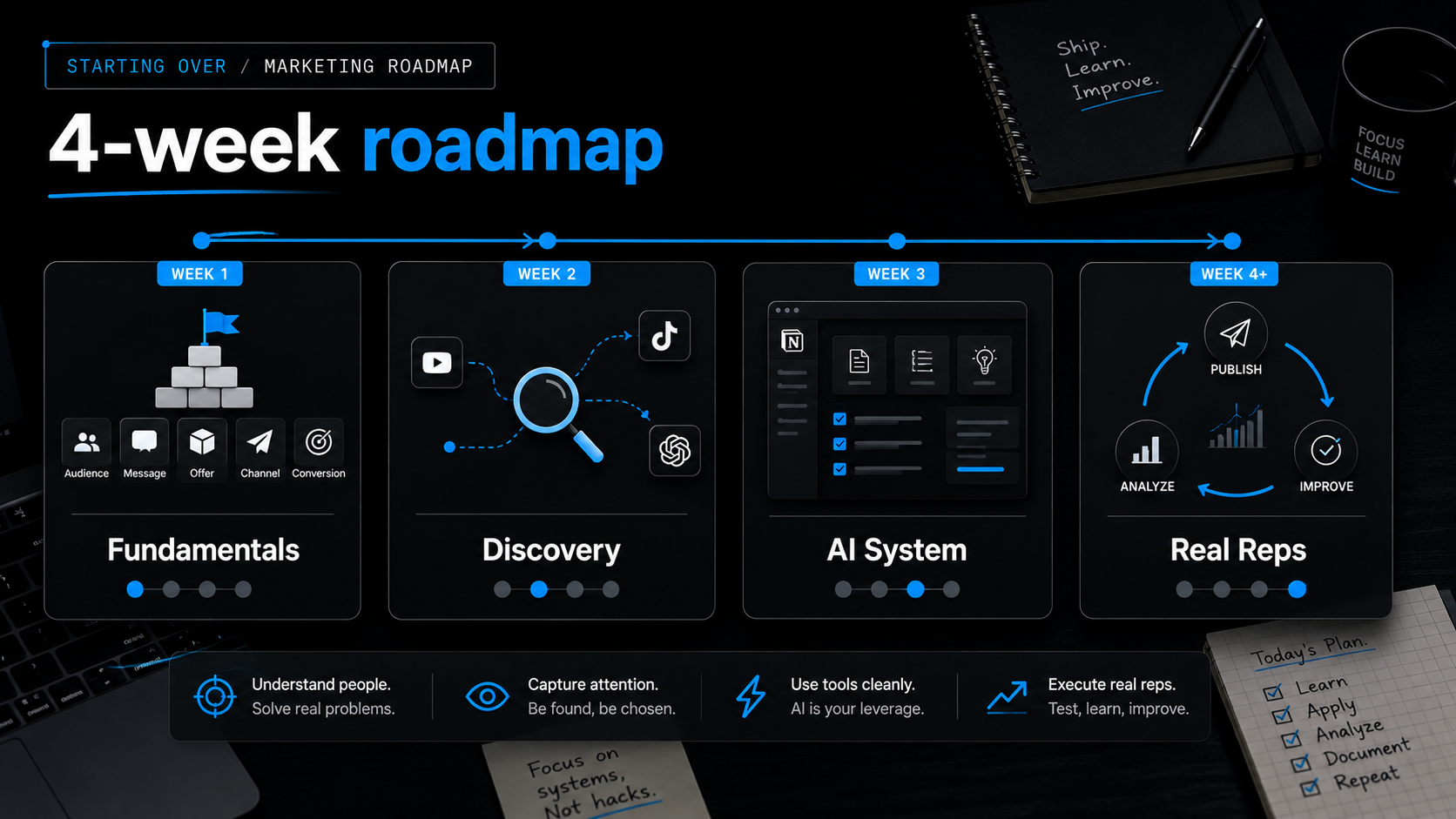
You do not need to learn everything at once. You need a clear order to follow.
If you need a simple structure to follow, break your learning down into this weekly progression:
Week 1: Learn the core fundamentals (Audience, Message, Offer, Channel, Conversion).
Week 2: Study modern discoverability (How search vs. discovery works across YouTube, TikTok, and AI platforms).
Week 3: Build a lean AI learning system to organize your research and reduce workflow friction.
Week 4 and Beyond: Start your practical reps. Pick a project, publish your work, and analyze your real results.
This roadmap isn't about mastering the entire industry in a month. It’s simply about getting your learning order right. Stop chasing random hacks every week. Focus on understanding people, capturing attention, using tools cleanly, and executing real reps.
If you are trying to learn marketing right now, drop a comment below with the one area that confuses you the most. Let’s figure it out together.
Noted? Great as always. I’ll catch you guys in the next one!
