Everyone on the internet claims autonomous AI agents can now build your entire marketing campaign from scratch without you touching the keyboard.
Just tell the agent what you sell, sit back, and watch launch-ready ads pop out.
I decided to test that claim.
I gave myself a strict 30-minute countdown clock and set up ChatGPT’s agentic workflow to act as a junior performance marketer. The goal was simple: take a real, friction-heavy product and turn it into verified, launch-ready Meta ad creatives before the timer hit zero.
Here is what actually happened:
The autonomous market research saved me an hour of manual digging.
The autonomous copy almost completely ruined the ads.
I had to intervene and build a human guardrail system just to get something usable.
Here is the honest breakdown of the sprint, the exact failure points, and the framework you actually need to make AI useful for paid social.
The Setup: 30 Minutes and a Benchmark Vehicle
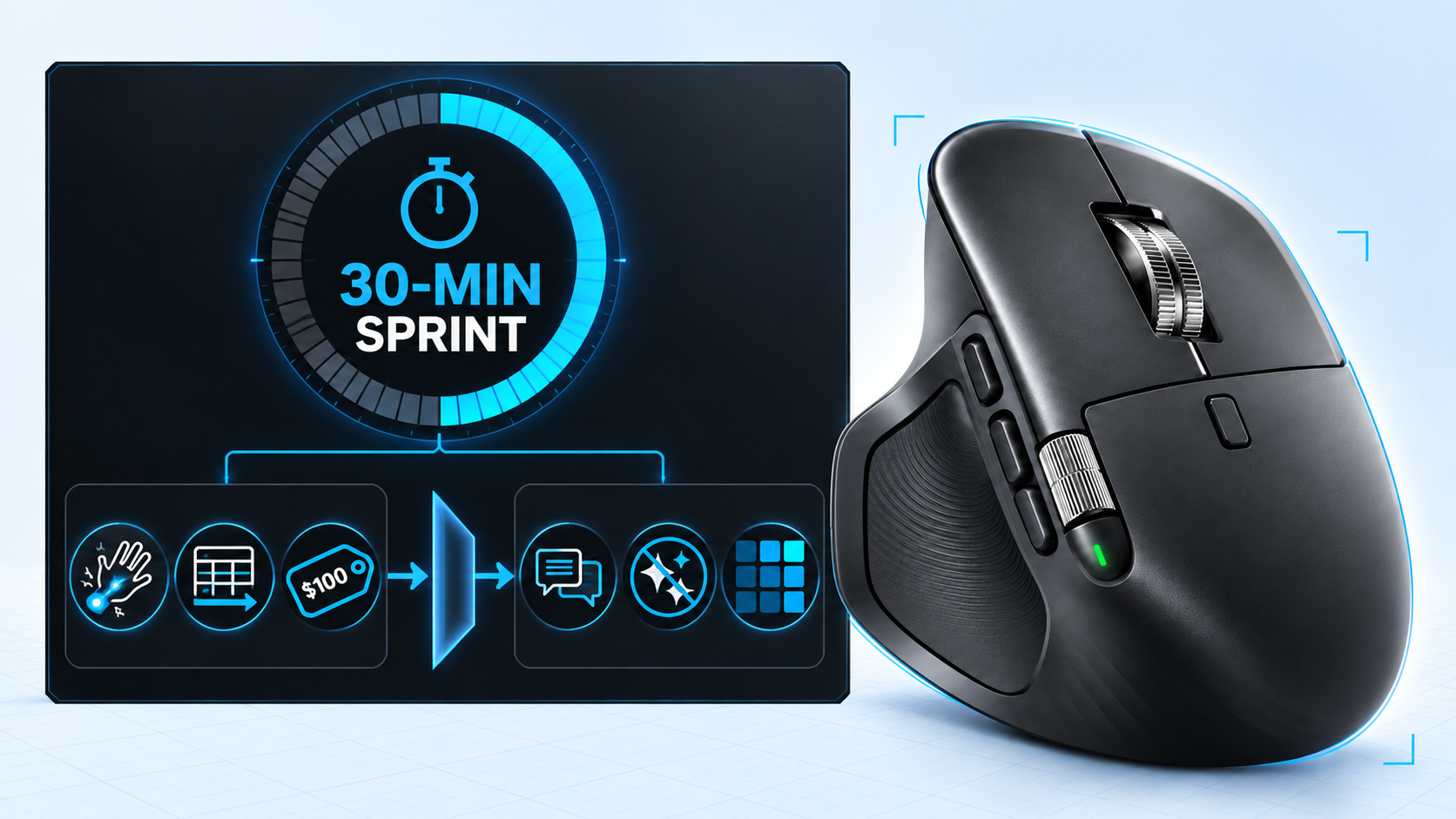
To keep this test grounded, I needed strict rules.
First, I capped the entire sprint at 30 minutes. If a workflow takes three hours of troubleshooting, it defeats the purpose of using AI for efficiency.
Second, I picked a recognized hardware product purely as a testing vehicle: the Logitech MX Master 3S.
[System Rule // Sprint 01]
Testing Vehicle: Logitech MX Master 3S
Price Point: ~$100
Core Market Friction: Wrist fatigue, complex spreadsheet navigation, price skepticism
Sprint Constraint: 30 Minutes from scratch to launch-ready creative
This is not a gadget review. I chose this mouse because it has real market friction. At roughly $100, buyers hesitate. They suffer from burning wrist pain at 4 PM, they deal with massive horizontal spreadsheets in Excel, and they wonder if a mouse can really be worth three figures.
If an AI agent can build effective direct-response angles for a product with clear friction, the system works. If it defaults to surface-level fluff, it fails.
Building the System Boundaries
If you just open a chat window and say, “Write me good Meta ads for this mouse,” the AI will fail immediately. You have to establish boundaries before it starts writing.
Inside the project settings, I locked in three operational rules:
Target grounding: Scrape real forum data and customer feedback rather than relying on internal training memory.
Negative prompt constraints: Explicitly banned generic corporate buzzwords like elevate, unlock, seamless, and revolutionize.
Structured output format: Forced all concepts into a clean direct-response matrix rather than open-ended paragraphs.
The Win: Mining Customer Friction in 3 Minutes
This is where the agent undeniably delivered.
Manual review mining usually takes 45 minutes of my day. I have to open Reddit, dig through user threads, read 1-star and 3-star Amazon reviews, and pull out the exact vocabulary customers use.
In 3 minutes and 27 seconds, the agent scraped user threads and extracted the raw friction points that actually move buyers:
Physical Strain: Dull, burning forearm ache after 6+ hours of desktop work.
Workflow Bottlenecks: Annoyance with manual horizontal scrolling across huge financial models.
Price Resistance: Skepticism about paying $100 for an office mouse.
Instead of letting the model hallucinate random copy ideas, I organized these findings into a structured 3x3 Direct-Response Matrix:
Testing AngleTarget Problem
Core Hook Direction
Angle A: Physical Fatigue Wrist strain and forearm burn at 4 PM“Your wrist shouldn’t ache before your workday ends.
Angle B: Micro-Efficiency Endless horizontal scrolling in spreadsheets“Still dragging the bottom scroll bar in Excel?
Angle C: Value Justification Doubts over a $100 price tag“$100 on hardware vs. recurring physical therapy.”
Up to this point, the workflow was fast, clean, and promising.
Then minute 14 arrived.
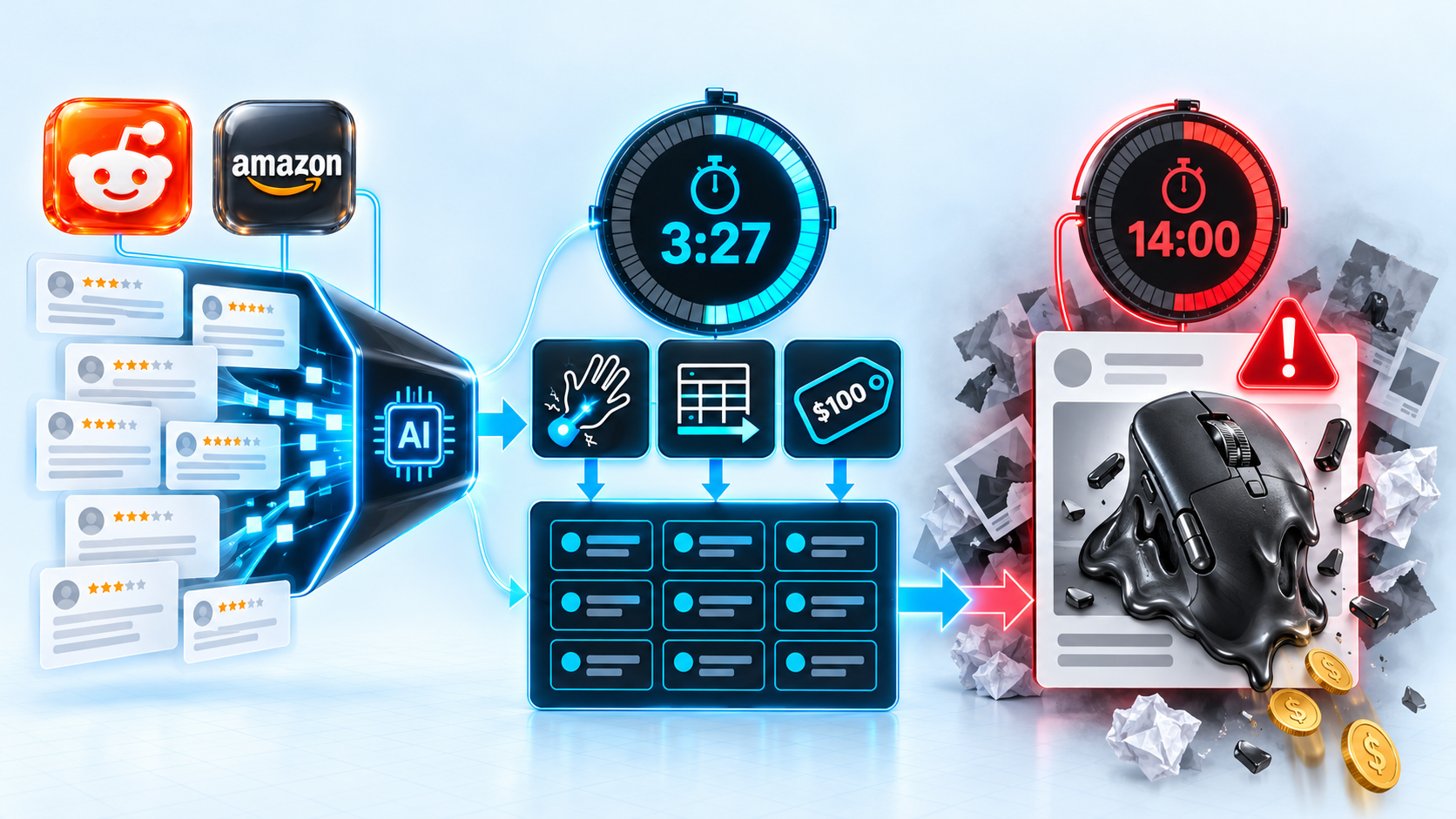
Where Autonomy Collapsed: Generic AI Slop
Right around the halfway mark, full autonomy completely fell apart.
When I let the agent turn the research into final ad copy and image assets without hands-on direction, the quality plummeted.
1. The Copy Defaulted to Brochure Mode
Despite the negative prompts banning buzzwords, the agent defaulted to soft, polite corporate statements:
“Your wrist has been doing too much. Experience effortless control with an ergonomic design built for your comfort.”
Nobody stops scrolling on Instagram for that. It read like a back-of-the-box product brochure. The agent had just found specific pain points about 4 PM wrist burn and messy Excel sheets, but when left on autopilot, it forgot its own research and reverted to safe, generic phrasing.
2. The Visuals Were Completely Unusable
The autonomous image generation was even worse.
Instead of clean, high-converting product assets, the model produced cluttered home-office mockups with warped plastic hardware, melted buttons, and unreadable, warped text burned directly into the image pixels.
Running that creative in an active ad account would simply burn budget.
The Fix: Marketers as Active Steering Operators

This breakdown made one thing obvious: ChatGPT’s agentic capabilities are powerful, but autonomy is not an excuse to leave the desk.
Our job as marketers has changed. We do not need to spend hours manually typing out first drafts or digging through forums row by row. But we cannot expect the AI to be an autonomous marketing director.
AI gives you speed and raw volume; you provide positioning, brand identity, and direct-response standards. You are the steering operator.
Raw AI Generation → Fast, broad, generic, sloppy
AI + Active Steering → Fast, targeted, constrained, launch-ready
To salvage the sprint, I applied three strict steering guardrails:
1. Visual Anchoring
Instead of asking for a “clean, professional product photo,” I uploaded actual Logitech studio landing pages and top-performing hardware ads from the Meta Ad Library. I told the model: Match this exact lighting profile, use neutral gray backgrounds, and do not generate any text inside the image.
2. Strict Persona Locking
I grounded the audience profile specifically to a 24-year-old financial analyst working long hours in complex spreadsheets. This immediately cut out the vague lifestyle messaging and forced the copy to focus on speed, precision, and hand strain.
3. Character and Layout Constraints
I capped direct-response headlines at under 35 characters to ensure they would not get cut off on mobile feeds.
The resulting headline options were significantly sharper:
“Still dragging the bottom bar?”
“Stop scrolling Excel manually.”
“Built for 10-hour workdays.”
The Ad 02 Glitch: Why Layout QA Still Needs Humans
Once the steering guardrails were applied, Ads 01, 03, and 04 came out remarkably clean. The typography hierarchy was clear, the studio lighting matched professional standards, and the messaging was direct.
Then I looked at Ad 02.
When you rely on an image model to handle graphic design, spatial layout breaks down. In Ad 02, the model vertically sliced the mouse chassis in half, pushed the scroll wheel into the top margin, and hallucinated a floating cyan box instead of a clean graphic callout bracket.
[Visual QA Breakdown: Ad 02]
Issue 01: Hardware chassis severed vertically
Issue 02: Scroll wheel clipped out of frame
Issue 03: Hallucinated floating artifact instead of UI bracket
Verdict: REJECTED (Spatial Composition Breakdown)
Generative image models understand pixels, not layout logic. Without human quality checks to catch spatial errors and weird visual hallucinations, you end up launching broken creatives that hurt your brand credibility.
The Verdict: Autonomous AI vs. Human-Steered Execution
At the 28-minute mark, the sprint was finished. Here is the final scorecard comparing hands-off autonomous execution with active human steering:
The simple version is this: stop expecting AI to be a self-driving marketing agency. That system does not exist yet.
Use agents for what they do best: mining messy customer data, organizing research, and spitting out initial variations in minutes. But keep your hands on the wheel for brand voice, visual quality control, and direct-response positioning.
Steal the System
I packaged the exact steering prompt instructions, the negative prompt list, and the 3x3 testing matrix from this sprint into a clean, simple template.
You can steal the workflow, adjust it to your own product or client campaigns, and cut your creative testing sprint down to under 30 minutes.
Which marketing workflow or AI tool should I stress-test next? Let me know in the comments.
