If you’ve spent the last two years collecting prompt templates, bookmarking cheat sheets, and typing the exact same context into ChatGPT every single morning, OpenAI just made that entire workflow obsolete.
I’m not an AI researcher, and I’m not an agency CEO selling overnight certainty. I’m an early-career marketer testing these tools in real time while building my own workflows. Over the last week, I’ve been testing OpenAI’s native background agents to figure out what their latest DevDay updates actually mean for daily marketing execution.
The short answer? The fundamental unit of marketing work has changed.
Here is the straightforward breakdown of what OpenAI announced, why interactive prompting is dying, and the three practical skills we need to build right now to adapt.
The 45-Second DevDay Briefing for Marketers
If you strip away the developer APIs and technical noise from OpenAI’s latest release, three core updates actually matter for marketers:
1. Persistent Context (Brand Memory): ChatGPT no longer wipes its memory clean every time you start a new thread. It retains internal brand rules, target audience pain points, and campaign criteria across conversations.
2. ChatGPT Space (Connected Workspace): Native connections to your calendar, email, cloud drives, and workplace apps.
3. OpenAI Dots (Native Background Agents): Continuous agents that run on event triggers in the background rather than waiting for you to manually open a window and type a prompt.
Connecting these three features together changes everything.
For two years, marketing with AI meant interactive prompting: open a chat box, paste context, write a prompt, wait for an output, and repeat the whole thing tomorrow.
Native agents change the operational model from interactive prompting to continuous delegation.
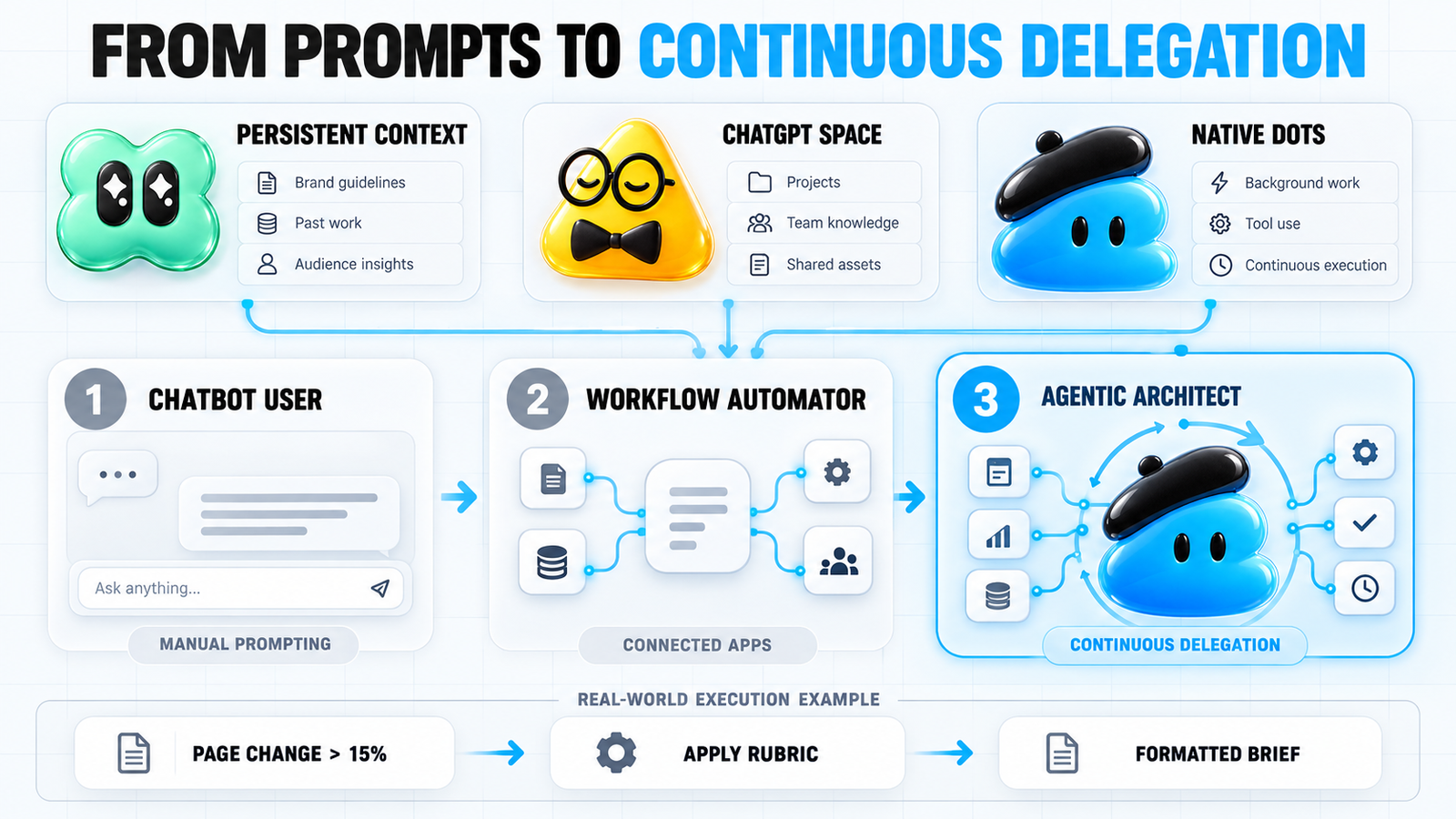
The 3-Level AI Marketing Maturity Model
To understand where you stand in this shift, look at how you currently interact with AI tools:
Level 1: Chatbot User. You use ChatGPT like a glorified spellchecker or quick draft writer. You type basic prompts and manually copy-paste text back and forth. Most marketers are currently stuck here.
Level 2: Workflow Automator. You use tools like Zapier or Make to connect basic apps together. You send webhooks from forms to spreadsheets, but the system lacks deep context or evaluation capability.
Level 3: Agentic Architect. You build background systems with persistent context, automated triggers, and clear quality-control guardrails. Your system executes work automatically when conditions are met.
Native Agents in Action: A 45-Second Proof
Here is what this actually looks like in practice.
I set up a native background agent (a Dot) to monitor competitor messaging changes across competitor landing pages.
I didn't open a chat box today. I didn't type a prompt. The agent executed automatically because its trigger condition was met: Landing Page Delta > 15%.
Because this agent operates with persistent context inside ChatGPT Space, it didn't just scrape raw text. It formatted the output using my exact internal brand guidelines, target audience objections, and campaign rubrics without needing a single reminder.
It solved the repetitive memory problem that makes standard ChatGPT threads annoying to manage.
The 3 Core Skills Marketers Need to Build Right Now
If prompt engineering isn't the competitive edge anymore, what is?
Here are the three specific skills early-career marketers need to focus on to survive this transition:
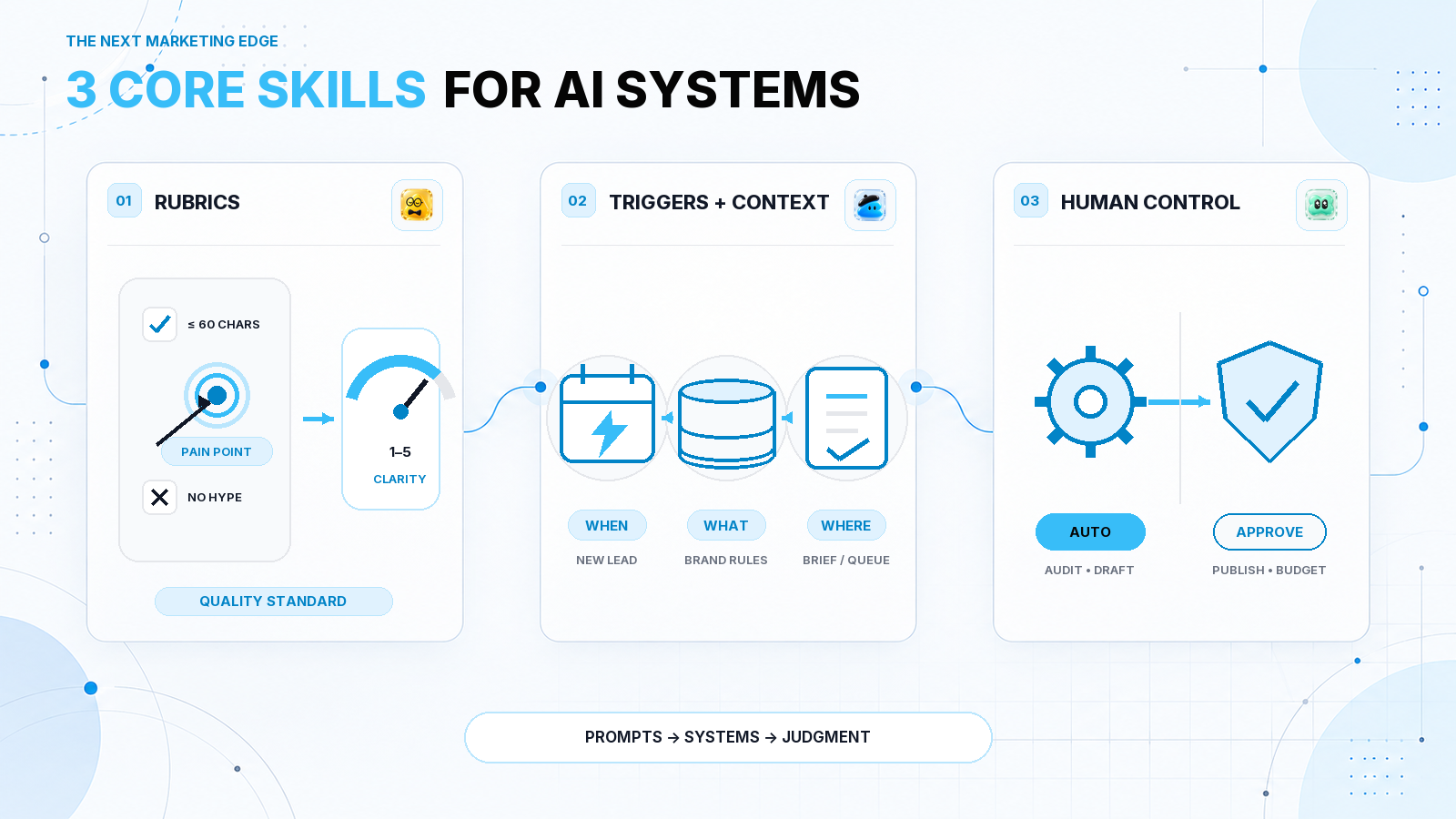
Skill 1: Rubric Writing over Prompt Crafting
Prompts tell AI what to generate right now. Rubrics teach AI how to evaluate its own work continuously.
Instead of typing “write a catchy ad headline” into a chat box every morning, an Agentic Architect writes a system rubric.
Basic Prompt (Old): “Write a catchy email hook for early-career marketers.”
System Rubric (New): Evaluation criteria: 1. Character limit: Under 60 characters. 2. Pain point: Target time management or skill decay. 3. Prohibited: No hype words (game-changer, hack, crush it). 4. Benchmark: Grade output on a 1–5 clarity scale before delivery.
Skill 2: Trigger & Context Mapping
An agent is useless if it doesn't know when to run or where to look.
Our role as marketers shifts from writing copy to mapping inputs:
What is the event trigger? For example, a new lead entering a sheet, an ad campaign reaching creative fatigue, or a scheduled weekly market audit.
What context does the agent need access to? For example, customer objection documents, past campaign performance, or brand tone rules.
Where should the output land? For example, a Slack digest, email brief, or content queue.
Skill 3: Human-in-the-Loop Quality Control
Autonomous agents without guardrails leak brand trust.
You are not being replaced by an agent; your role is evolving into the Quality Control Director. Your job is to define explicit boundaries:
Autonomous Execution: What is the agent allowed to do automatically? For example, scrape data, run audits, or format internal draft briefs.
Human Approval Required: What requires explicit sign-off before going live? For example, publishing public content, sending client communications, or spending ad budget.
The Brutal Reality Check
Let’s be completely honest: native agents right now are early, messy, and prone to breaking.
If you build an agent without strict rubrics and clear boundaries, it will hallucinate and fail. AI is an execution assistant, not a substitute for strategic thinking. If your core marketing strategy is weak, an automated agent will just execute bad strategy faster.
Here is the practical takeaway: stop treating prompt templates as the end goal. Use them as a starting point for documenting the context, trigger, rubric, and approval boundary behind the work. That is how you move from asking AI for outputs to designing systems you can actually trust.
What repetitive marketing task are you still prompting manually every week?
