My AI Workflow for Dissecting Notion’s Marketing Funnel (And Where AI Failed)
When I first started learning growth marketing, I made a mistake that almost every beginner makes:
I studied tools in isolation.
I looked at Meta ads separately. I looked at email copy separately. I looked at landing pages separately.
Because everything was disconnected, understanding how real companies actually grow was completely confusing to me. It didn't make sense until I mapped the entire funnel out visually as a connected system.
Over the past three days, I tested a specific AI research workflow to see if ChatGPT could help me reverse-engineer Notion’s product-led growth (PLG) onboarding funnel.
In this post, I’m sharing my exact 4-phase research process, the prompts I used, the exact moment ChatGPT completely failed, and how I manually fixed it to build a visual marketing case study you can steal for your own portfolio.
The Problem with Isolated Marketing Tactics
Most early-career marketers try to build portfolios by showing isolated campaign ideas or surface-level summaries.
The reality? Employers and clients don't hire people who just know how to run an ad or write a headline. They hire people who understand connected systems—how headline copy feeds into onboarding friction, how onboarding feeds into email retention, and how email retention triggers workspace monetization.
To demonstrate that level of systems thinking, I chose Notion. They are one of the cleanest examples of product-led growth in modern SaaS.
My goal was simple: use AI as a thinking assistant to reverse-engineer their core funnel layers into a single visual map.
Phase 1: Deconstructing Landing Page Copy

The first step was extracting Notion’s core message architecture.
Instead of just reading their homepage and taking random notes, I copied the raw text from their primary landing page and fed it to ChatGPT using a structural copywriting prompt.
The Phase 1 Prompt:
Act as a growth marketer and conversion copywriter. I am going to provide you with the raw text from Notion's primary landing page. Analyze the text and break it down into a structured, high-fidelity marketing audit.

Execute this breakdown across four explicit vectors:
1. The Core Hook: What specific structural pain point is the header and hero copy targeting?
2. Audience Segmentation: How does the copy shift its messaging when targeting an individual vs. a scaling team?
3. Friction Reduction: Identify the exact words or phrases used to eliminate user doubt before the primary CTA button.
4. Value Pillars: List the 3 primary pillars of their product-led growth positioning as derived strictly from the text.

Do not give me generic textbook definitions of marketing concepts. Base your entire analysis only on the text provided below. Output your response in clean, bulleted headers with bold inline terms.

[PASTE RAW NOTION LANDING PAGE TEXT HERE]
The Insight:
The AI broke down the psychological triggers quickly. It highlighted something critical: Notion’s primary positioning focuses heavily on team collaboration rather than individual note-taking.
By framing the product around team friction rather than personal organization, their messaging subtly pushes higher-value account creation right from the hero section.
Phase 2: Auditing Onboarding Friction
Analyzing a landing page only gives you 10% of the picture. The real marketing happens during user activation.
I signed up for a new Notion account live, taking screenshots and documenting every step of the onboarding sequence. Notion introduces clear micro-segmentation questions right after email verification (e.g., asking if the workspace is "For myself", "With my team", or "For school").
I used AI to audit why a multi-million dollar PLG company intentionally adds friction at this exact moment.
The Phase 2 Prompt:
Act as a Product-Led Growth (PLG) systems engineer. I am running an onboarding experiment on Notion. During the initial sign-up flow, they force the user through a series of micro-segmentation questions (e.g., asking if the workspace is "For myself", "With my team", or "For school", followed by team size and role selections).

Analyze the mechanics of this friction point:
1. Strategic Intent: Why does a multi-million dollar PLG brand introduce intentional friction right after the email verification step?
2. Personalization Mechanics: How do the options "For myself" vs. "With my team" change the immediate workspace layout and the subsequent user activation milestones?
3. Upgrade Pathways: Predict the specific product triggers or paywall limitations that will be served to a "With my team" selection compared to an individual user based on standard workspace monetization loops.

Provide a highly objective architectural breakdown. Keep sentences short, punchy, and focused entirely on retention loops.
The Insight:
Intentional friction isn't a mistake—it's a filter. Notion uses these quick questions to immediately customize the template architecture of the user's workspace, setting up clear paywall triggers down the road based on whether the account is a solo user or a team.
Phase 3: The Inbox-to-Product Activation Loop

Next, I opened the first automated welcome email sent immediately after account setup.
Email marketing shouldn't exist in a vacuum. A welcome email’s only job in a SaaS funnel is to force the user out of their inbox and back into the product to reach an "Aha!" moment.
The Phase 3 Prompt:
Act as a behavioral lifecycle marketer. I am pasting the raw text of the first automated onboarding email sent by Notion immediately after a user completes the account setup.

Deconstruct the conversion architecture of this email using these three lenses:
1. Behavioral Trigger: What specific "Aha! moment" or immediate setup action is this email trying to force the user to complete within the product?
2. Asset Framing: How are their pre-made templates presented in the copy to lower the cognitive load of a new user facing a blank workspace?
3. Urgency and CTA Mechanics: Analyze the link placement and the exact phrasing of the call-to-action. How does it optimize for click-through rate back into the active workspace state?

Isolate the exact sentences where the copywriting successfully bridges the gap between the inbox and user retention. Avoid fluff; deliver raw execution logic.

[PASTE RAW NOTION ONBOARDING EMAIL TEXT HERE]
The Raw Friction Point: Where AI Completely Failed
This is where the experiment hit a wall.
After feeding ChatGPT the landing page copy, the onboarding steps, and the email copy, I asked it to map the strategic connection between the onboarding email and the actual live workspace interface.
It gave me completely generic answers.
Despite giving it detailed prompts, ChatGPT defaulted to high-level textbook definitions of product-led growth. It gave me surface-level theory instead of actual execution steps.
Why? Because AI cannot see or experience what happens inside live software UX. It doesn't know how a real user interacts with a canvas, where cognitive overload happens, or how subtle template menus guide a human being to click an upgrade button.
This was a key lesson for me: AI is a powerful research assistant, but it cannot replace manual testing.
The Human Override
I stopped relying purely on the AI. I took my raw sign-up notes, logged back into the workspace, and manually tracked how Notion uses pre-made workspace templates to trigger paid upgrade paths.
Once I had the real user experience mapped out manually, I fed those specific observational notes back into ChatGPT to synthesize everything into a single macro system map.
Phase 4: Synthesizing the Connected Funnel Map
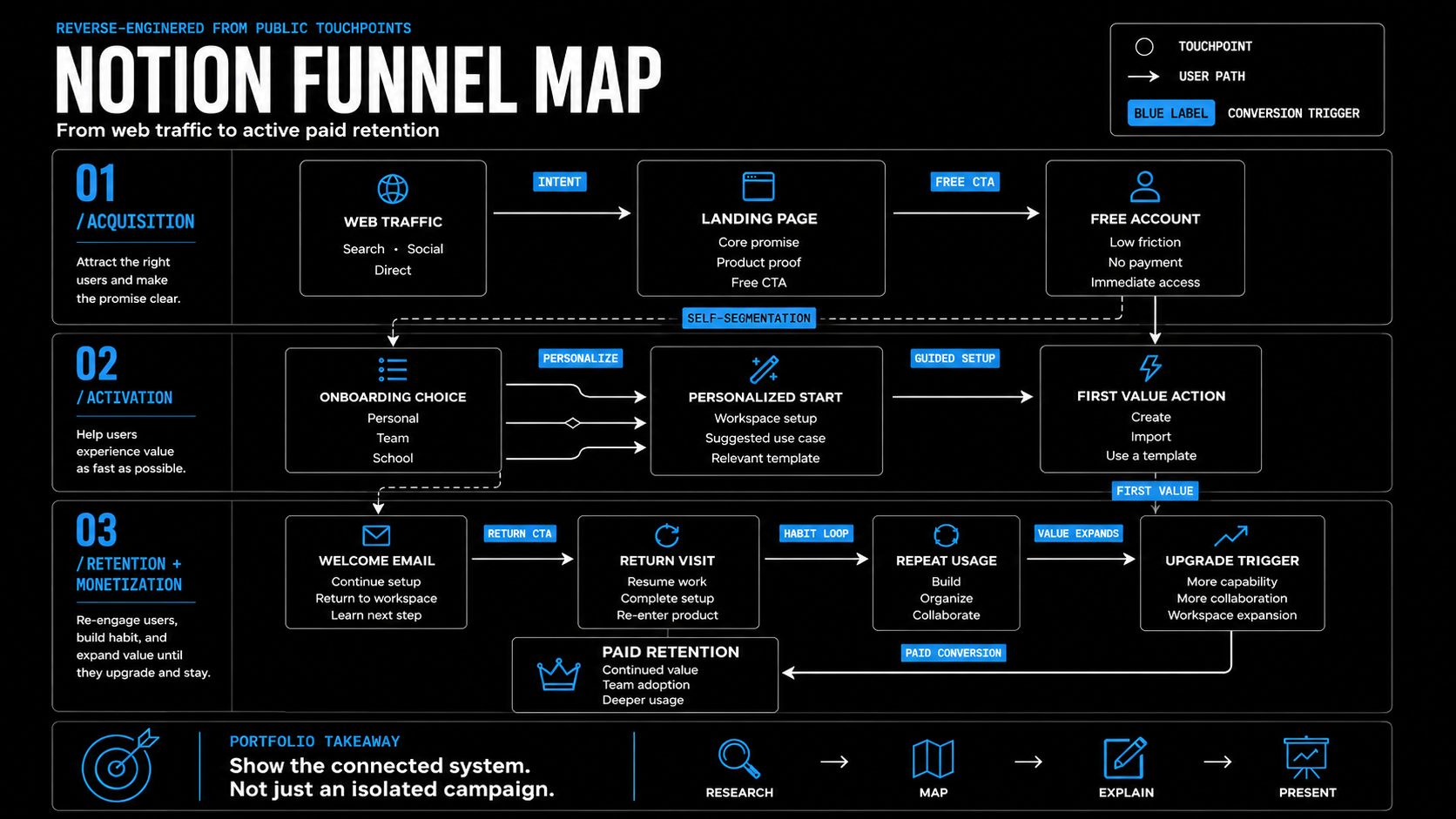
To turn isolated data points into a visual system asset, I used one final synthesis prompt to generate a structured node layout.
The Phase 4 Prompt (The Human Override Prompt):
Act as a senior growth architect. We have analyzed Notion's landing page messaging, their sign-up segmentation, and their immediate lifecycle email. I need you to synthesize all these isolated layers into a single, connected macro system blueprint.

Generate a clean, text-based Funnel Map using a step-by-step markdown node structure. Format it exactly like this:

[STEP 01: TRAFFIC ENTRY] -> Action: [Insert primary action] -> Core Hook: [Insert messaging trigger]
   │
   ▼
[STEP 02: SIGN-UP FRICTION] -> Fields: [Insert data collected] -> Strategic Intent: [Insert intent]
   │
   ▼
[STEP 03: INSTANT INBOX LOOP] -> Email Trigger: [Insert welcome email focus] -> Activation Metric: [Insert target action]
   │
   ▼
[STEP 04: WORKSPACE ACTIVATION] -> Interface State: [Insert template entry point] -> Retention Trigger: [Insert monetization path]

Ensure every single step explicitly highlights where the user transition happens. Keep the layout highly structured, left-aligned, and clean so it can be translated directly into a visual engineering blueprint.
By combining AI analysis with real manual UX testing, I ended up with a clean, connected map of Notion's activation strategy.
Resource Alert: If you want to replicate this exact research process for your own portfolio, you can access the full setup inside my [AI Funnel Case Study Playbook].
How to Use This to Build Your Marketing Portfolio
If you are trying to get hired as a growth marketer, digital builder, or strategist, writing standard summaries won't make you stand out.
To build real authority, you need to show proof of work and systems thinking:
Don't just analyze copy: Show how that copy connects to user activation inside the product.
Don't rely 100% on AI tools: Use AI to break down text and structure data, but always run manual tests to capture real human UX friction.
Turn research into visual assets: Convert your findings into structured node maps, diagrams, or visual breakdowns that prove you understand the complete end-to-end user journey.
Final Takeaway
Learning marketing doesn't come from memorizing isolated definitions. It comes from picking apart real systems, testing tools, hitting friction points, and mapping out how things actually work under the hood.
AI speeds up the process significantly, but the human oversight—the manual testing and synthesis—is what creates real value.
Steal this 4-phase prompting framework, pick a SaaS brand you use every day, and build your own visual funnel case study.
Which brand funnel should I dissect next? Let me know, and I’ll test it in the next experiment.
