Stop Sending 10-Page Portfolios: How I Built an AI Case Study That Gets Replies
I spent months sending a bloated 10-page portfolio to marketing applications, only to get hit with absolute silence. Hiring managers do not have time to browse generic coursework or abstract classroom projects. They care about whether you understand their specific product problems and can drive growth.
You do not need private corporate metrics or confidential revenue reports to prove you can do the job. You only need public customer feedback, active ad copy, and an analytical workflow to reverse-engineer a brand's growth strategy.
I tested this exact workflow on public data from the $100M direct-to-consumer brand Ridge Wallet using Gemini Notebook (formerly NotebookLM). The outcome was a info-dense 1-page campaign teardown deck designed to pitch directly to a VP of Growth.
Why Standard Marketing Portfolios Get Ignored
Most entry-level marketing portfolios fail because they show broad, hypothetical work. Hiring managers skim portfolios in seconds, searching for proof of strategic thinking rather than graphic layout skills.
Traditional Marketing Portfolio1-Page Reverse-Engineered Teardown
10+ pages of school projects and generic text.
1 page focused on a specific company's actual growth gaps.
Relies on hypothetical scenarios and fake clients.
Built on real customer friction and live ad claims.
Dumped into ATS application forms with hundreds of candidates.
Pitched directly to decision-makers via targeted outreach.
Focuses on past academic activities.
Focuses on actionable campaign concepts for immediate testing.
The 4-Part AI Teardown Framework
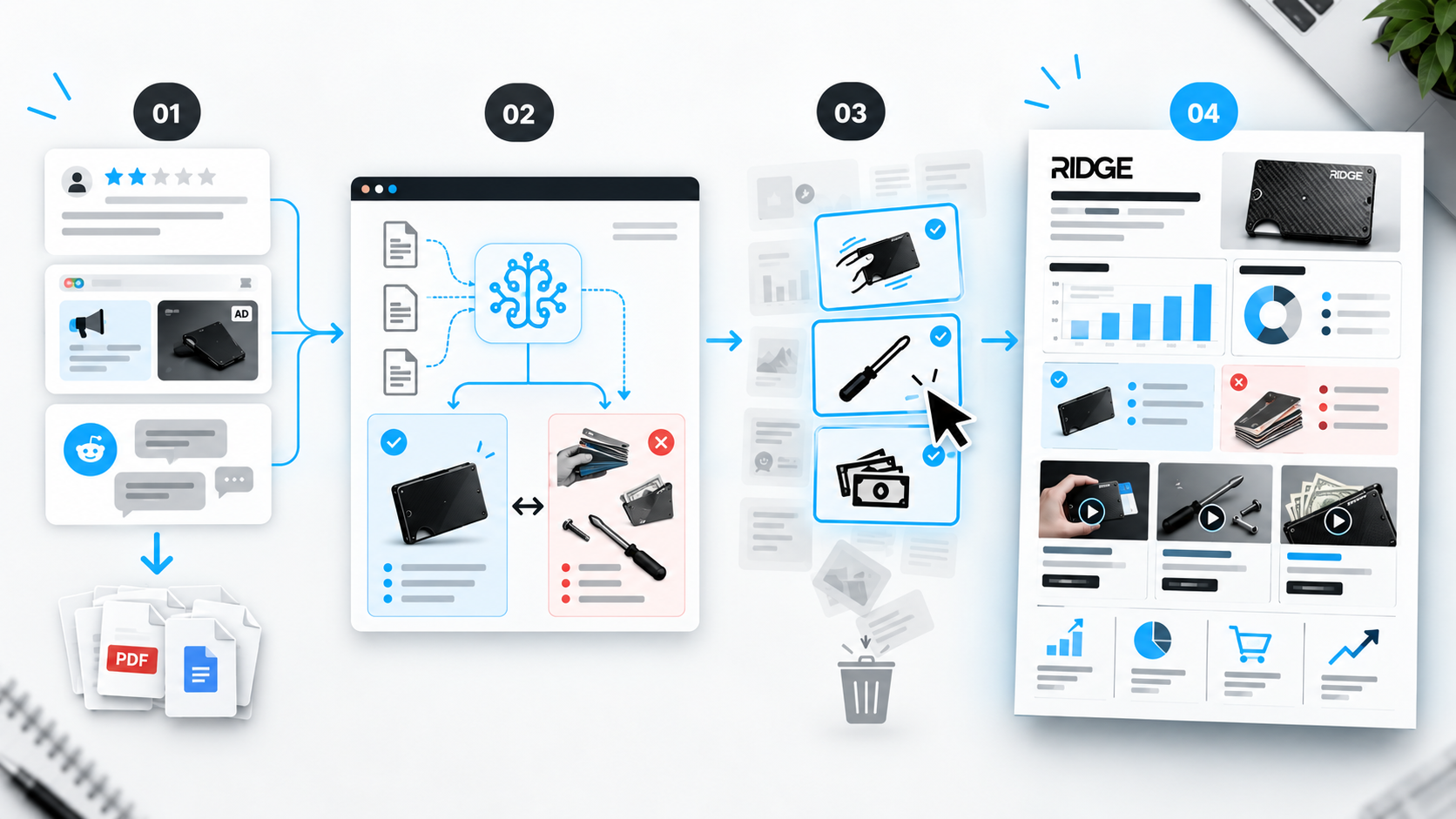
Building a job-winning case study does not require weeks of design. It requires a structured process that combines AI processing power with strategic human editing.
[Gather Public Data] ➔ [Run AI Audit] ➔ [Filter & Edit] ➔ [Format & Pitch]
1. Gather Raw Public Data
You need three public data sources to map what a company promises against what its customers actually experience:
Trustpilot & Amazon Reviews: Look specifically for 2-star and 3-star negative reviews to uncover usability friction and customer complaints.
Meta Ad Library: Copy active ad copy to identify the brand's primary promises, value propositions, and positioning.
Reddit Discussions: Search communities like r/EDC, r/wallets, or product-specific subreddits for unfiltered customer sentiment.
Because Gemini Notebook does not process raw image files reliably, convert all text, web pages, and screenshot data into clean PDF or Google Doc files before uploading.
2. Run an Analytical AI Audit
Load your source files directly into Gemini Notebook. Instead of asking broad or basic questions, feed the tool a detailed master prompt instructing it to act as a senior growth strategist.
Instruct the AI to cross-reference product friction against active ad claims. In the Ridge Wallet test, the AI isolated a core strategic gap:
Ad Promise: "We killed the bulge" and built the last wallet you will ever buy.
Customer Reality: Heavy checkout anxiety, middle-card retrieval fumbling, cash strap bulk, and loose screw maintenance.
3. Apply the Strategic Human Edit
Raw AI output gives you organized research data, but strategic selections provide real proof of competence. Throw out generic AI fluff and focus on concrete, testable concepts.
For the Ridge Wallet audit, I filtered the AI's findings down to three specific messaging concepts:
The 3-Second Checkout: Address middle-card retrieval friction by teaching card-ordering techniques in cold paid social ads.
The Screwdriver Story: Frame maintenance (loose screws and elastic wear) as expected ownership behavior using retargeting ads rather than letting it surprise buyers post-purchase.
Cash Changes the Profile: Use qualification ads to show realistic cash trade-offs, filtering out bad-fit buyers before checkout to improve downstream conversion quality.
4. Build a 1-Page Tear-Down Deck
Take your selected insights and design an info-dense PDF asset. Keep the document structured and scannable:
Executive Summary: Define the core problem as a promise-to-use mismatch.
Research Inputs: State the exact source data used (e.g., 3 Meta ad copies, 25 review excerpts, 3 Reddit threads).
Customer Friction Map: Display coded mentions of recurring usability complaints.
Messaging Gap Matrix: Compare ad claims directly against customer friction.
Campaign Concepts: Show visual ad frames with copy hypotheses and placement tactics.
Measurement Plan: Outline clear metrics (CTR, CVR, return reasons, support tags) to measure success.
You can build this document using Google Docs, Canva, or Adobe Express.
How to Distribute Your Case Study
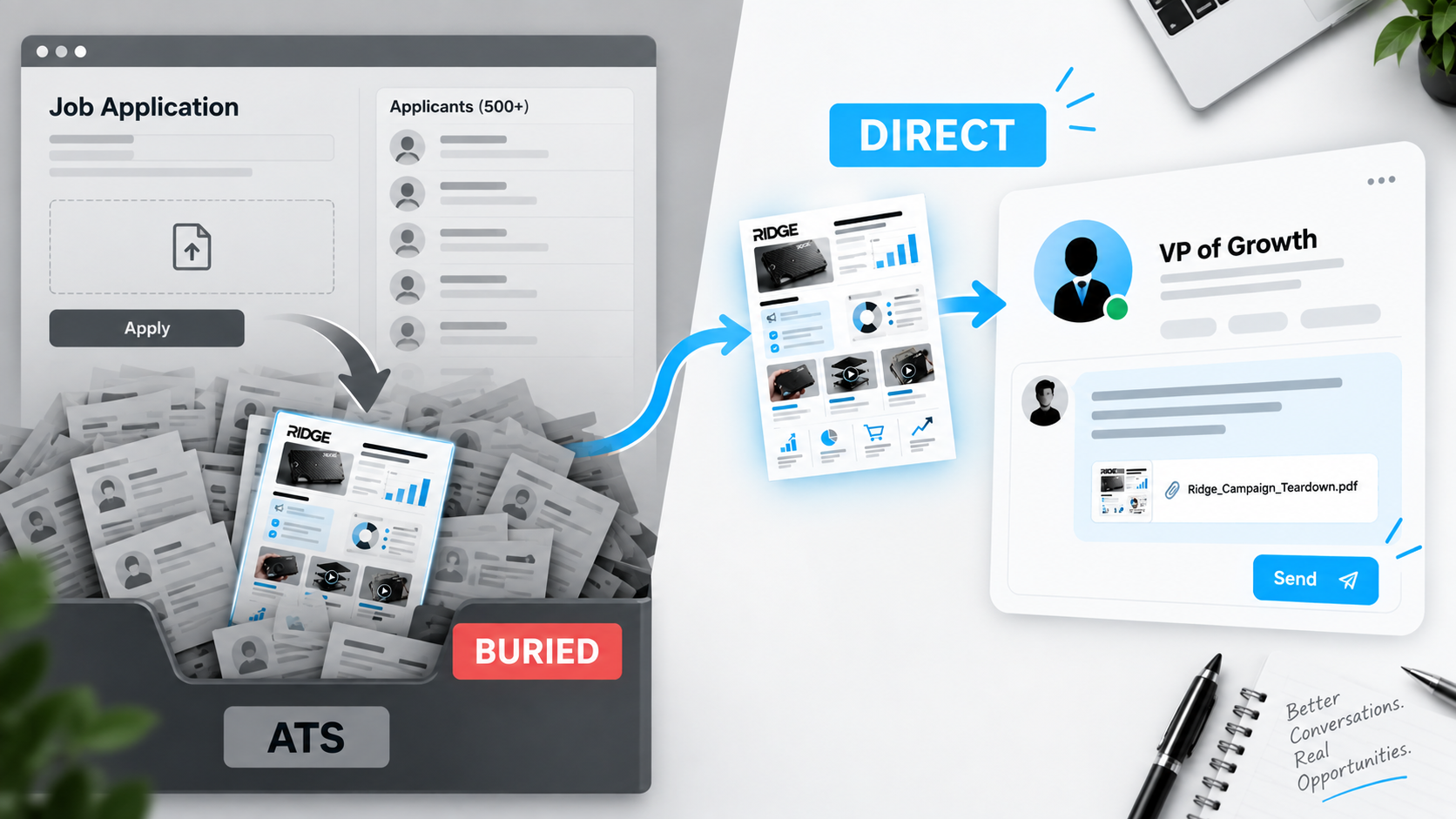
Do not submit this asset through an online job application form where it gets buried by applicant tracking software. Send it directly to decision-makers.
Direct Outreach Method:
Find the VP of Growth, Head of Marketing, or Marketing Director for your target company on LinkedIn.
Send a short connection request or direct message.
The 2-Sentence Pitch Template:
"Hey [Name], instead of a standard resume, I ran a public teardown comparing [Company]'s active ad hooks against customer friction points from Trustpilot and Reddit. Put together a 1-page campaign teardown deck—mind if I drop it here?"
This approach shifts you from a passive job seeker asking for attention to a peer offering practical growth insight.
Start Building Your Teardown Asset
Stop relying on generic resumes and 10-page portfolios. Select a company you want to work for, gather their public data stack, and run this workflow.
Drop a comment below with the brand you are applying to, and we can break down their ad stack and customer friction data together.
